A child in Primary 4 who cannot read. That is not a rare story in Nigeria. That is a pattern. And it is one I encountered up close — not through a report, not through statistics, but sitting in a classroom, watching it happen in real time.
A school contracted me to teach phonics because their students were struggling. Not nursery students finding their feet. Students in Primary 4 and Primary 5 — children who had been in school for years — who could not read properly. Could not spell. Could not pronounce words they had seen hundreds of times.
The problem was not the children. The problem was the foundation. Nobody had ever taught them sounds.
Why Sounds Are Everything
Phonics is the foundation of reading. Before a child can read a word — any word — they need to understand that letters make sounds. That sounds combine to make words. That when they encounter an unfamiliar word, they can break it down, sound by sound, and decode it themselves. That one skill unlocks everything else: reading, writing, spelling, pronunciation.
I watched it happen in real time. A child staring at a word they couldn't say. I'd tell them: sound it out. And you'd see the concentration on their face — the effort — sounding each letter, blending them together — and then suddenly, the word. They got it themselves.
That moment never gets old.
We started with the basics — the individual letter sounds from A to Z. Then we moved into blends, consonants combining with vowels. Then digraphs — two letters coming together to make one sound. Then vowel combinations. Each layer building on the last. Each lesson giving the child more tools to decode the world around them.
When a child learns to sound out a word they've never seen before — and gets it right — something shifts in them. They realise they can figure things out themselves. That confidence doesn't stay in the reading lesson. It goes everywhere.
The Other Problem Nobody Talks About
But as I kept teaching, I noticed something else. Something that went beyond the students.
The teachers were struggling too.
Not because they didn't care. Not because they weren't trying. But because most teachers in Nigeria have never been given a structured framework for teaching phonics. They don't know exactly what sounds to introduce at what stage. They don't know the sequence — what comes first, what comes next, what builds on what. They're improvising. Doing their best without a map.
I remember sitting in on a staff discussion one day and hearing a teacher say something that stayed with me — that helping children master sounds was one of the most effective strategies for teaching reading, but that she never quite knew how to structure it properly. She knew it mattered. She just didn't have the tools.
That conversation confirmed what I was already thinking.
The problem wasn't just the students. It was the entire system around them. And if I was going to solve this properly, I had to solve it for both.
What I Built
The phonics and literacy app started as a simple assessment tool. But the more I thought about it, the more I realised that assessment without curriculum was only half a solution. A teacher needs to know what to teach before they can assess whether it was learned.
So I built both.
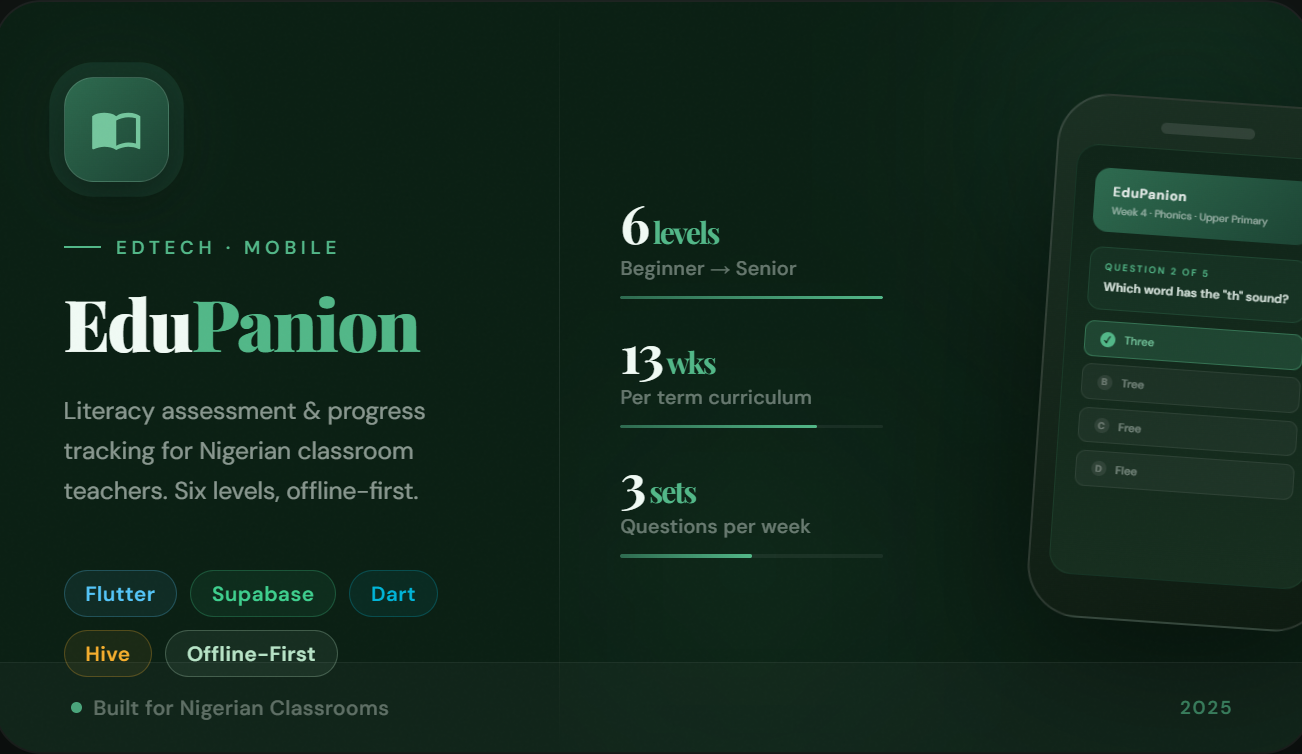
The curriculum side of the app follows a structured phonics framework — drawn from the same approach used in the UK and Australia — adapted for Nigerian classrooms from Nursery 1 upward. It gives teachers a week by week guide: exactly what sounds to introduce, in what order, at each level. No guesswork. No improvising. A clear, structured path that takes a child from basic letter sounds all the way through blends, digraphs, and complex vowel patterns.
The teacher opens the app, sees what this week's lesson is, and knows exactly what to teach. That alone changes the classroom.
The assessment side gives teachers the tools to measure what their students have actually learned. For lower classes, two assessments per topic. For upper classes, three. So the teacher isn't just delivering content — they're tracking progress. They know which students are keeping up and which ones are quietly falling behind.
The Part I'm Most Proud Of
But there is a third layer — and it is the one I am most proud of.
I integrated AI, powered by Groq, that analyses each child's assessment results and generates personalised insights for the teacher. Not generic feedback. Not just a score. Specific, actionable guidance: here are the exact sounds this child is struggling with, here is what that tells us about where the gap is, here is what you can do about it.
Every child gets seen. Every weakness gets named. Every teacher gets a clear path forward — not for the class as a whole, but for each individual student.
A teacher with thirty students in a Nigerian classroom cannot always give each child individual attention. The AI doesn't replace that human relationship — it supports it. It does the analysis so the teacher can focus on the teaching. That's the right use of technology in education.
Why This Matters Beyond One School
Nigeria has a literacy problem. It is not hidden. It is visible in classrooms across the country — in children who reach upper primary still unable to read fluently, in students who struggle through secondary school because the foundation was never properly laid, in adults who carry the weight of that early gap for the rest of their lives.
The solution is not complicated. It is structured, consistent, sound-based teaching from the very beginning. Phonics taught properly, in the right sequence, assessed regularly, with support for the teachers delivering it.
What has been missing is the tool that makes that possible at scale — in any classroom, with any teacher, regardless of their experience or training level.
That is what I built.
I am a developer. But I am also a teacher. And this app exists because those two parts of me looked at the same problem and refused to accept that nothing could be done about it.
We are rolling it out. And I believe it is going to change things — one classroom, one teacher, one child at a time.
If you work in education in Nigeria — this was built for you.
A structured phonics curriculum, weekly lesson guides, student assessments, and AI-powered insights. Built for Nigerian classrooms from the ground up.
Learn More →